This Post is directed towards the fellow Pakistanis who either live or have grown up in the Urban Hubs of Pakistan.
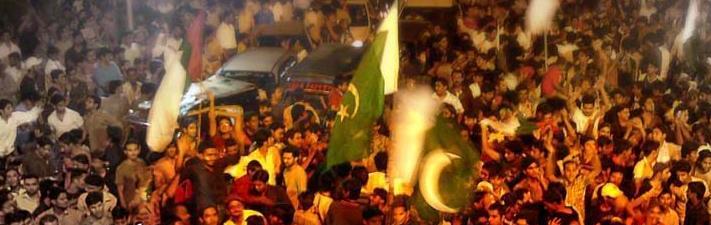
Yesterday for the first time I spent the Independence Day outside Pakistan. And when most friends back home were busy celebrating our 63rd Independence Day at funfairs, concerts and exhibition matches or were at home watching special televised transmission, the only link available to me to join in the celebration was to browse Pakistani News websites. I was of course envious of my friends but I felt it to be fair deal given that I, unlike many, had seen the Pakistani Team lifting the cricket world cup live at Lord’s, less than two months ago.
I had thought that getting a detailed sketch of the festivities would rejuvenate my patriotic zeal and give me the confirmation that Pakistan and Pakistanis have the will to rise above any crisis. This was a much needed feeling especially when the last couple of years saw the International media giving Pakistan every possible detestable label from ‘the most dangerous country in the world’ to a virtual ‘failed state’.
But in between reading news articles glorifying the spirits of the common Pakistani, I came across the two most disturbing incidents. In the first one a youth in Lahore standing under the shade of Minar-e-Pakistan waved the Pakistani flag fervently and then committed suicide by consuming poison. His last words as heard by bystanders were “Long Live Pakistan, Down with Unemployment.” He had given up on his life, but he did not give up on the country.
The second one by contrast involved no loss of life but brought more shame than the former. Due to security concerns the official flag hoisting ceremony at the parliament house by the Prime Minister was shifted to the Jinnah Convention Centre. Our political leadership did not risk their lives but gave up on the most time honored tradition which symbolizes the supreme sovereignty of the parliament after God.
These incidents begged me to ask myself the question which I have been putting off for over a month that is this the saddest Independence Day we have seen as a nation? Or was it 1949 when the young nation had to celebrate the day without its father Mohammad Ali Jinnah? Or was it in 1959 when the nation marked the day while its co-founder and then Prime Minister H. S. Suhrawardy, the very man who moved the 1946 Delhi Convention Resolution, was imprisoned by a Military Dictator after being framed in the most dubious and ridiculous claim which even embarrassed the very military court which sentenced him.
To many I believe the saddest independence day perhaps would be of 1972, when for the first time we observed the festivities without our east wing and Dhaka was never to see another crescent star flag hoisted on its soil. To add to the grief Pakistan marked the independence that year negotiating the freedom of 90,000 of our army jawans being held as prisoners of wars. Tariq Ali notes that Pakistan lost half its navy, a quarter of its air force and a third of its army but there is no count of how many, doctors, teachers and intellects we lost. All I know is Pakistanis forced 75 million other Pakistanis to turn into Bangladeshis.
To many perhaps the darkest hour of Pakistan was behind them but its most hypocritical display was yet to come. On 14th august 1979 when Pakistanis safely celebrated their independence within their country’s borders, over half a million muslim biharis left stranded in Bangladesh after 1971 longed to return home. Their love for their homeland was so sincere that they set on a journey of 1200 miles to march across India to Pakistan on foot. All they ended up achieving was being arrested by Bangladeshi authorities. And for our part for our brothers we could offer nothing but a cold shoulder.May be because unlike 1947 we already had a country and thus we did not feel the need to facilitate such a migration and unlike the celebrated muhajareens of 1947 these half a million biharis would have only been a burden upon us.
But more astonishing was the fact that those who were home in Pakistan seemed to be only celebrating partition rather than independence. After all at a time when the country’s most sacred document, the constitution, stood suspended, when the country’s highest authoritative body, the parliament, stood dissolved, and in a year when the country’s elected Prime Minister stood at the gallows. What was so free about Pakistan?
But today Pakistan seems to have achieved a lot. We are a nuclear power. We possess the 7th largest army in the world. At this hour when I am writing this article Pakistan enjoys democracy albeit a fragile one. Pakistan’s leadership feels proud to have earned the alliance of the world’s superpower and Pakistan takes it in its stride that it is fighting the war for the world. Ignorance! Yes this ever growing ignorance is precisely the biggest and most constant achievement of Pakistan. Jinnah’s young nation of 1949 has still not matured in 2009.
Neither nuclear weapons nor alliances with a super power guarantee the protection of a country. When the Soviet Union broke into more than 20 pieces it had the biggest nuclear arsenal in the world and if it not first, it was itself the second biggest super power. What it did not have at the end of the Soviet Invasion was national spirit. It had lost unity. How dare we fight wars for the world when we cannot fight for the independence of hundreds of Pakistanis detained by CIA in Guantanamo, Morocco and Saudi Arabia? After 62 years we stand at point zero, finding Unity, Faith and Discipline.
Thus yesterday I felt, we had the saddest independence of our history. When the youth of Karachi gathered in the national stadium for a grand concert, the youth of Orakzai Agency in Waziristan took cover to prepare itself from the next drone attack. When the president of Pakistan was busy handing out flats to the People’s Party faithful who lost their lives in the 18th October blast, 25 million youth of this country were hoping only to get a job if nothing more. And for those for whom the wait has been too long, they committed suicide under the shade of the very monument which marks our freedom.
Our major political parties shamelessly abused public property by hoisting their party flags on every possible street light in their respective stronghold of Lahore and Karachi, but not one popular leader of Pakistan dared raising the Pakistan flag in Baluchistan. The Pakistani media very enthusiastically reported hoisting of Pakistani flags in the Indian Kashmir and political talk shows shamelessly seized the moment to remind India of Nehru’s promise which he made on the floor of United Nations, that India will hold a free referendum in Kashmir on its right of self determination. But can today a Hamid Mir, Javed Chaudhary, Shahid Masood or Zaid Hamid run a sincere media campaign asking the Pakistani Government to hold a similar referendum in Baluchistan? And if they do, will our Government oblige? The answer quite simply is no. Because the litmus test for democratic Pakistan is not the overwhelming majority of Baluchistan which might choose to stay with Pakistan but it is that insignificant minority which would want to secede.
We should not be angry on Mir Suleman Dawood for celebrating Baluchistan’s independence in London on 11th August this year, but ashamed that we have actually conceded enough ground for Baloch leaders to exploit. Remember Mohammad Ali Jinnah was an Indian Nationalist before he became the Father of Pakistan and Sheikh Mujeeb-ur-Rehman was an ardent Pakistani before he founded Bangladesh. Writing about the fall of Dhaka earlier in this article and mentioning the state of Baluchistan reminded me how Pakistan has played the very role of All India Congress of 1935-37 which we were taught to detest in our history classes in primary school. What puzzled me that though back in my history class my own and many other inquisitive minds were pacified by the standard rhetoric of Hindu-Muslim differences, I wondered what difference caused our separation in 1971 and the current crisis in Baluchistan. The answer was not ethnic or social polarization it was ignorance.
It is the same ignorance reflected in our condemnation of the Pakistani Taliban. One can believe that Baitullah Mehsud was a traitor and served foreign agencies but did each and every member of his 30,000 troops also take an oath of allegiance to what we refer to as the Mossad-Raw nexus? Or were they all foreigners from Uzbekistan to begin with? No! Many were Pakistanis from the most poverty stricken areas of Pakistan, such as interior Sindh, Southern Punjab, the Tribal belt and most of Baluchistan. I have never come across or read about a terrorist who was a former student of Lahore’s Aitchison, Karachi’s Grammer School or Islamabad’s Roots, which of course is a good omen. But instead of realising this material fact in a positive light and spreading the outreach of such schools our inherent ignorance encourages us to rather indulge in the school-madarassah debate. Hence we all play our part in giving birth to this dichotomy.
We very bluntly blame the local madarassahs for giving young student extremist ideologies. What we don’t realise is that we defame an institution which is feeding, fostering and educating more than 3 million homeless and poor students. On the other hand the aforementioned elite schools of Pakistan have never published a policy to keep a reserved quota of seats for admission of homeless, orphaned or poor students. And these three are not alone, but they merely lead the list of thousands of such private schools which with a certified standard of education, effective administration and immense resources have made nil contribution to the public welfare structure of Pakistan. But the students of these institution which also includes me, ignorantly claim madarassahs to be the catalyst of terrorism.
The focus of our attention should not be that the big difference between the youth committing suicide in front of Minar-e-Pakistan and the one blowing himself up in front of government buildings is of ideology. Rather the fact begging our attention is that the common ground between those two is lack of a better or for that matter any opportunity to earn a respectable livelihood.
We as Pakistanis have condemned a significant portion of our society to die. And our growingly selfish outlook on this condemned lot is visible in our reaction to their deaths. If it was at a crowded hotel, we get furious because it could have endangered us but if it was a quite death by consuming poison we don’t even bother to offer prayers for the departed. In either case, a Pakistani died. But as ignorance also invites cowardice and tolerance for cruelty we continue to stay quite against the authoritative state and on the cruelty of the state policy which is the real causal effect of this extremism. And most importantly we don’t point fingers at ourselves. After all either we elect the democratic government or we quietly tolerate the military dictator.
How can we possibily celebrate independence when our own minds are not free. In a famous political talk show the host asked all the panellists what is one thing each Pakistani can do every day for 10 minutes to play his/her part to change the country. I thought to myself that may be we just need to only dedicate 10 minutes of our today to save this country. If only for 10 minutes we take off our spectacles of ignorance and think that is our own opinion on our country’s economic policy, foreign policy, development policy and defence policy independent?
I don’t know about you, but mine wasn’t. Some was influenced by a Religious Scholar, some a famous political commentator, some by a politician I admire and some by my father. My own mind as a Pakistani was not free. My own effort to use my brain and indulge in critical thinking was minimal. Allama Iqbal gave us vision for freedom of self, khudi, but I realised that our fundamental quest was more basic; it was awareness of self. To quote Faiz Ahmed Faiz ‘Meri zaat ka jo nishan milay — Mujhe raz-e-nazm-o-jahan mile’ (that if I find the sign of myself, I would perceive the secret of the world’s design)
No wonder we live in a country where the greatness of a political leader is not judged by the scandalised life she lived which actually materially affected us but it is judged by the way she died, a death which had no actual impact on our standard of living. We live in a country where millions of tax payer’s money is spent to get the United Nations Fact Finding mission to investigate that death, but where the Power ministry denies Transparency International the documents showing the agreement between the old and new owners of Karachi Electrical Supply Corporation, the importance of which cannot be highlighted enough.
We live in a country where the supporters of political parties with a strict hereditary flow of power, PPP and PML (N), dwarf the supporters of the two parties cleansed of any feudalistic hierarchy, MQM and Jamat-e-Islami.
We burn houses by the dozen in Gojra on alleged blasphemy because the local cleric told us to. But I don’t blame the cleric I blame the mob who were so aloof of their own Holy Book, the sanctity of which they were protecting, that they did not realise that the Holy Book does not prescribe any punishment for abusing the book.
We live in a society where the urban youth takes offence of being branded as Taliban nation and runs massive letter writing campaigns to start the Swat operation which we knew would have drastic consequences. But a worse label of being branded as a poor, indebted and puppet state does not bother us. The black turban Talibans saw the wrath of every outspoken, educated and civilised Pakistani on the streets Karachi, Lahore and Islamabad. But these sensitive Pakistanis contained their condemnation of American drone attacks to their air conditioned drawing rooms. Hence it is not surprising that this ignorant attitude is now reflected in our state policy. At the time of writing this article it has been four days since the drone attack in Wana killed 10 Pakistani civilians and the Pakistani Government has lodged no protest at any official or unofficial level. Our ignorance has very easily outlined our comfort zones outside of which we feel no discomfort to let our national interests and our nationals die.
But I still wrote this article because one single event in the last couple of years still kept the hope alive, that we might have become deaf, dumb and blind as a nation but we are not dead. That event was the movement for the restoration of the judiciary. And even though the struggle came to be popularly known as The Lawyers movement the real impetus came from all walks of life; be it street hawkers or university students, be it housewives or businessmen, be it human right activists or politicians, be it news anchors or a newspaper vendors I saw all raising their voices for one cause. The struggle although was for a channelled and restricted cause did show that it is not hard to achieve Jinnah’s code of success; unity, faith and discipline. Sadly though many taking part in that struggle might not have realised that what they achieved was much more than the restoration of the Chief Justice. The visuals of 16th March, as seen in Lahore, the same city where the Minar-e-Pakistan stands made me believe that may be this nation wants to use every possible life line and it will not commit suicide.
But with this optimistic conclusion we still need to address our deep rooted notion of freedom. That does only Western, Indian or any other physical occupation qualifies as a compromise on our freedom? If so, than may be I have mistaken in my synopsis that 14th August today only symbolises partition and not Independence. And so with my apologies I wish my brothers and sisters a very Happy Independence day although we are only availed as much freedom as our Prime Minister had to hoist the flag at parliament house. But even after conceding so much ground to our collective ignorance I still cannot wish Independence to Afia Siddiqui and many others like her.