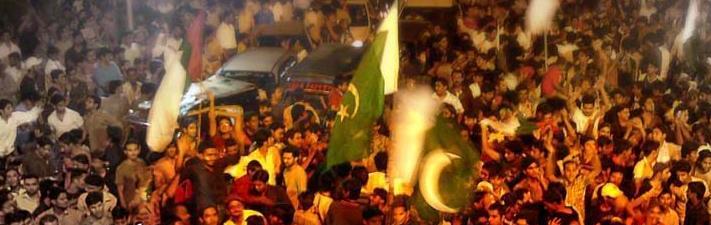

Yesterday I spent 12 hours at the Dharna at Teen Talwar,
Clifton, against the Shia genocide. At the time of writing, the Dharna is still
underway and it has been over 24 hours since its start now.
When I joined the Dharna at Bilawal House last month, I had
arrived 10 hours after the proceedings had started. The place was already packed
with thousands of Shia protesters and being a Sunni I was intimidated. The
repeated chants of “Labaik Ya Hussian” and “Ya Ali” were deafening and frightening.
I was confused whether I should join in as I actually pondered if these chants
were blasphemous.
I felt alienated listening to various references to the
Imams who aren’t discussed in our mainstream curriculum. Speaker after speaker
made references to how the Shia population was a target, how they were the oppressed,
how they were the victims. I felt frustrated thinking that the Quetta bombing
was first and foremost a human tragedy, a national tragedy so why wasn’t it
being treated as one.
I looked around and found the answer. If the protest was not
a national protest, then why should I expect the victims to be identified as
Pakistanis. If the organizers were Shia and the vast majority of protesters
were Shia then why shouldn’t they have the right to highlight their
victimization at a sectarian level.
Belonging to the majority sect of Pakistan, it was embarrassing
to find myself in the minority in this protest.
At that time I realized that I was not intimidated because
the Shias were hostile or unfriendly upon learning about my sect. In fact every
Shia who learnt about my identity, came forward, shook my hand and thanked me
for coming. The fear crept from inside from my deep rooted bias which is
instilled in most Sunni children as how Shias secretly hate Sunnis. Sadly, the
opposite appeared to be true.

Hence, this time I had made a point to be at the Dharna from the very
start and encouraged all my Sunni friends to do the same. When I arrived along
with my friends, there were just three people standing on Teen Talwar looking
in all directions trying to spot co-protesters. We walked up and joined in. People
drove by paying no attention. 10 more people joined in, but the bystanders
appeared unbothered. Suddenly, I heard someone scream at the top of their voice
“Naray-e-Haideri!”. The cars slowed down, the traffic Police took notice. I
turned around to find that the voice was not of a Shia protestor, but of my
friend, Nadir, a Sunni. I couldn’t hold back the smile on my face. What started with
3, reached the strength of close to 3000 in a few hours.

This lot of protestors appeared more mature and well aware than
that at Bilawal House. This time slogans were not chanted against America but
against Taliban. Western Powers were not blamed for sectarian violence, but
Lashkar-e-Jhangvi and Sipah-e-Sahaba were bluntly blamed. This Dharna was not
in denial. They were willing to accept that terrorism is a home grown problem.

Protesters stopped chanting “tum kitnay shia maro gey?” and
asked “tum kitnay insaan maro gey?”
The goods things from the Bilawal House Dharna were also
carried forward here and one had to be there to note those finer details. Teenage
boys who were risking their lives by volunteering as security guards (unarmed),
then there were volunteers who had made a makeshift kitchen and were serving
tea, then there were those who were distributing juices, biscuits and biryanis,
then there volunteers as young as 5 and as old as 70 carrying out trash bags
collecting used paper cups and wrappers. No public or private property was
allowed to be damaged. In all of those volunteers there were lessons to be
learnt; the lesson of selflessness, the lesson of civic responsibility, the
lesson of unconditional patriotism and the lesson of community.
Unfortunately, one sad fact also remained common between
both Dharnas. Sunnis were again a minority. And now I want to ask the Sunni
readers why? Why is Hazara killings not our concern? Why is Shia genocide not
our concern? If it is then where were the Sunni Protesters? Why did we let this
Dharna be reduced to a Shia protest too? Does only the death of a Sunni boy or
girl has the exclusive privilege of being reported as a Pakistani death?
For those Sunni readers who really aren’t bothered about a
Shia death, they should know that not all Hazaras who died in the bomb blasts
were Shia.
Every single time such a tragedy takes place the ignorance
of the Sunnis results in only more ridicule for Pakistan at the international
level as we expose to the world how polarized and inhumane we are that we cannot
even condemn terrorism and loss of innocent lives as one united nation. But at
home, the damage is worse. We make our Shia countrymen realize that they are
alone. We tell them that we will celebrate 14th August together,
that we will dance on the streets upon our cricketing victories together, that
in the good times we will be there, but that’s where the brotherhood stops. In
the time of mourning and against threat you are alone. At most, we will extend
our sympathies on social networking websites.
Attending the protest as a Sunni did not make me a better
Pakistani, but what did sitting at home and just updating your facebook status against
the genocide made you?

There were thousands of Pakistani students who took part in
the “Occupy University” Campaign in England in 2008 in protest against Israeli
occupation of Gaza. Sadly, most of them choose to sit at home now because
apparently Palestinians are more Pakistani than Hazaras.
Step up and step out. Be a part of something. Make the
protest Pakistani. Make this tragedy Pakistani. Make the demands Pakistani.
Make yourself Pakistani.

I end with the poetry I recited at the Dharna highlighting not just the impotence of the Government against these atrocities but also the ignorance of the majority of Pakistanis not willing to come out on the streets for active protests.
